When A Minecraft Movie launched on April 4, 2025, it transformed gaming’s most iconic sandbox into a live-action phenomenon that shattered records while dividing audiences. Directed by Jared Hess and featuring Jack Black and Jason Momoa, this Warner Bros. production grossed $961 million worldwide, proving that unconventional gaming adaptations can achieve blockbuster success despite mixed critical reception.
The film’s journey from initial concept to box office triumph took over a decade, surviving multiple directors and countless script rewrites. What emerged is an energetic, chaotic adventure that became the second-highest-grossing video game film of all time, trailing only The Super Mario Bros. Movie.
Table of Contents
Overview & Production Background
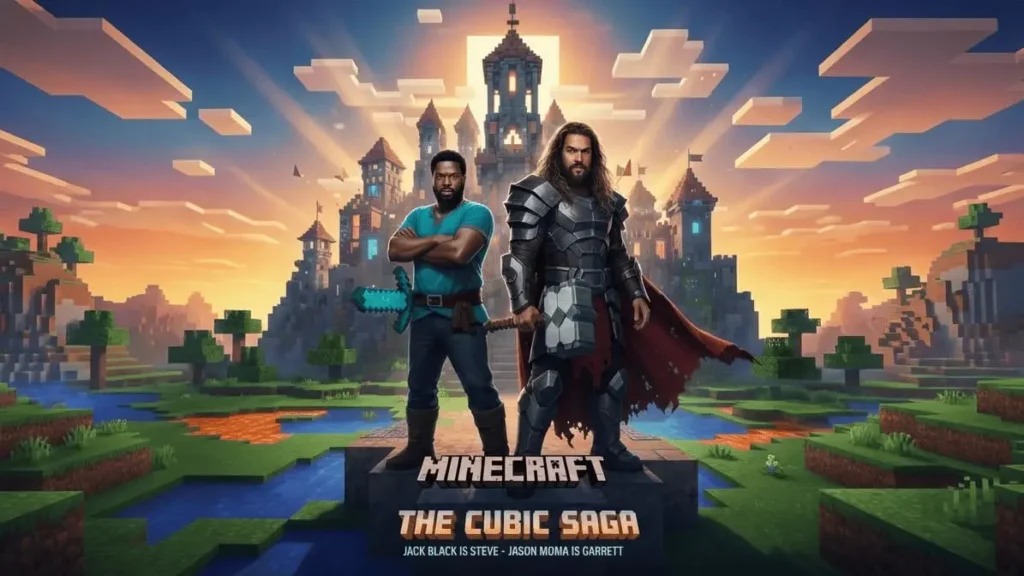
A Minecraft Movie is a fantasy adventure comedy that uniquely blends live-action performances with extensive CGI to recreate Mojang Studios’ iconic blocky aesthetic. Running 101 minutes with a PG rating, the film targets family audiences while attempting to honor the creative spirit that made Minecraft a global phenomenon with over 300 million players worldwide.
Plans originated in February 2014 when Minecraft creator Markus “Notch” Persson announced Warner Bros. was developing an official adaptation. The project cycled through directors Shawn Levy, Rob McElhenney, and Peter Sollett before Jared Hess (Napoleon Dynamite) revitalized it in April 2022. Producer Mary Parent of Legendary Entertainment recognized that Hess’s quirky sensibility could distinguish the film from conventional blockbusters.
With a $150 million production budget, filming occurred from January to April 2024 near Auckland, New Zealand. The screenplay credits five writers—Chris Bowman, Hubbel Palmer, Neil Widener, Gavin James, and Chris Galletta—with an unprecedented twenty-one additional contributors listed for “Additional Literary Material,” explaining both the film’s scattered narrative and occasional creative inspiration.
Plot Summary: Journey to the Overworld
The Core Story
The narrative centers on four mismatched individuals from fictional Chuglass, Idaho, who find themselves transported into the Overworld—a bizarre cubic dimension where imagination becomes reality. Led by Garrett “The Garbage Man” Garrison (Jason Momoa), a washed-up arcade champion clinging to 1989 glory, the group includes teenage robotics prodigy Henry (Sebastian Hansen), his protective sister Natalie (Emma Myers), and hustling real estate agent Dawn (Danielle Brooks).
Upon arrival, they encounter Steve (Jack Black), a quirky crafter who discovered a portal years earlier and made the Overworld his home. Together, this unlikely quintet must navigate hostile Piglins, zombie hordes, and nighttime dangers while searching for a way back to reality. Their journey becomes a quest for rediscovering creativity and imagination they’ve lost in mundane life.
The backstory reveals young Steve discovering the Orb of Dominance and Earth Crystal in an abandoned mine, which created the portal to the Overworld. His idyllic existence shatters when he stumbles into the Nether—a hellish dimension ruled by Malgosha, a gold-obsessed piglin sorceress who imprisons him and suppresses creative expression.
The climax emphasizes teamwork and creative problem-solving as Henry’s engineering skills, Steve’s crafting expertise, and Garrett’s gaming knowledge prove essential to defeating Malgosha and her army. The resolution sees Steve choosing to return to the real world, suggesting creativity has value in both dimensions.
Cast Performances & Character Analysis
Jason Momoa’s Fearless Comedy
Jason Momoa delivers his most unhinged performance, completely abandoning the suave intensity audiences expect from Aquaman. Sporting a hot-pink tasseled leather jacket and impressively unkempt perm, Momoa fully commits to portraying a schlubby has-been whose glory days are decades behind. He reportedly gained weight specifically for the role, consuming copious pasta to achieve Garrett’s average physique—a stark contrast to his typically athletic build.
Critics universally praised Momoa’s fearless comedic timing. His chemistry with Jack Black drives many successful scenes, creating a buddy comedy dynamic within the larger adventure. His willingness to embrace physical comedy and self-deprecation provides genuine humor even when the script falters.
Jack Black as Steve
Jack Black’s portrayal represents both the film’s greatest strength and most divisive element. Rather than creating a distinct character, Black essentially plays himself—or the manic persona audiences expect from Jumanji and Borderlands. His performance features exaggerated physicality, improvisational energy, and musical interludes, including the viral “Steve’s Hot Lava Chicken” song.
Black reportedly engaged in method preparation, immersing himself in Minecraft gameplay to understand crafting mechanics. This dedication manifests in scenes where he enthusiastically explains recipes with infectious energy. However, critics argued his over-the-top approach prevented Steve from developing meaningful emotional depth beyond being a vehicle for Black’s comedic stylings.
Supporting Cast Excellence
Emma Myers (Wednesday) brings grounded authenticity as Natalie, portraying a young woman burdened by adult responsibilities with genuine pathos. Sebastian Hansen’s Henry serves as the emotional core, his portrayal of a grieving, socially awkward teenager resonating with themes about finding belonging through creativity. Danielle Brooks delivers warmth as Dawn, though her character remains somewhat underdeveloped.
Jennifer Coolidge provides memorable comedy as Vice Principal Marlene, whose romantic subplot with a Minecraft villager offers unexpected adult humor. Rachel House voices villainous Malgosha with theatrical menace, while Jemaine Clement, Kate McKinnon, and Matt Berry round out creature voice roles.
Visual Effects & Cinematography
Visual effects supervisor Dan Lemmon oversaw the monumental task of translating Minecraft’s distinctive aesthetic into live-action cinema. Three major VFX studios—Sony Pictures Imageworks, Wētā FX, and Digital Domain—collaborated to maintain the game’s iconic blocky geometry while creating a visually coherent world accommodating human actors.
The production used extensive green screen technology with in-studio lighting to create Overworld environments. 3D models were imported into Unreal Engine to generate virtual sets, allowing actors to interact with the cubic landscape during filming. Everything visible adhered to Minecraft’s cubic construction—trees composed of perfect blocks, water flowing in geometric patterns, even chickens maintaining their charmingly awkward cubic forms.
Visual Controversy: While VFX teams successfully recreated Minecraft’s geometric world with impressive fidelity, integrating photorealistic human actors into the stylized environment created what many critics described as an “uncanny valley” effect. The jarring contrast between realistic skin textures and cubic sheep divided audiences—some found the visual mash-up charming, others deeply unsettling.
Several prominent Minecraft YouTubers, including Mumbo Jumbo, contributed to production design to ensure authenticity. This community collaboration aimed to preserve the game’s spirit while adapting it for cinematic storytelling.
Critical Reception: The Great Divide
Critics’ Mixed Verdict
The film received mixed reviews, earning 48% on Rotten Tomatoes from 197 critics and 45 on Metacritic. The critical consensus acknowledged colorful aesthetics and appealing chemistry between Black and Momoa while criticizing conventional narrative structure.
Positive reviews praised self-awareness and refusal to take itself seriously. Critics appreciated Hess’s quirky directorial touches and performances’ infectious energy, arguing the film succeeded by embracing absurdity rather than attempting prestige cinema.
Negative reviews focused on predictability, shallow character development, and perceived waste of Minecraft’s creative potential. Several critics expressed disappointment that a film about a game celebrating player creativity delivered such a formulaic narrative. The visual design’s jarring quality drew particular scrutiny, with comparisons to early 2000s green-screen effects.
Audience Enthusiasm
General audiences responded far more positively. CinemaScore gave the film a “B+” average, while 84% of audience ratings on Rotten Tomatoes were positive. Notably, children under 12 rated it five out of five stars, demonstrating the film successfully connected with its target demographic.
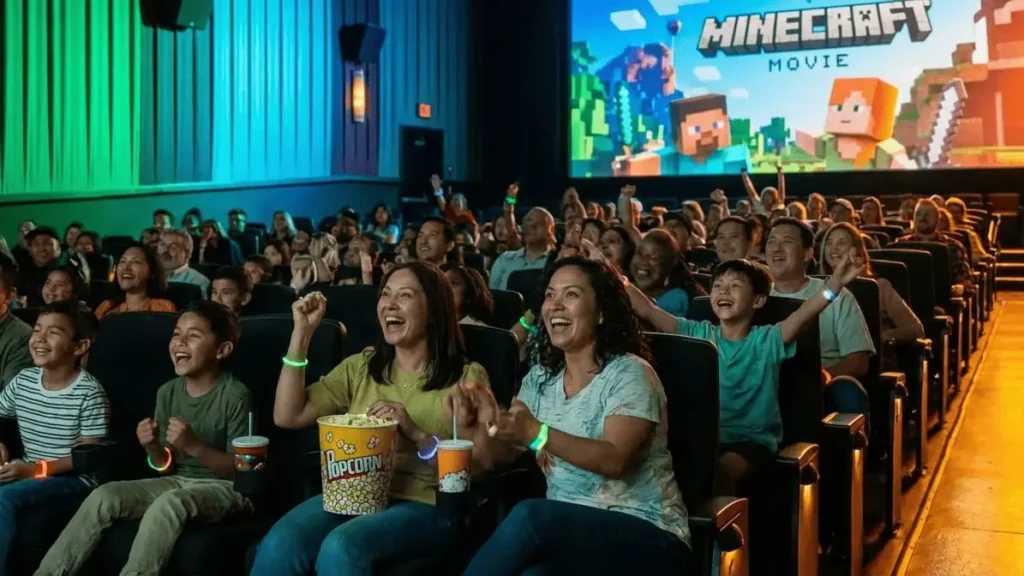
Younger viewers embraced meme-worthy moments, particularly “Chicken Jockey” sequences and “Steve’s Hot Lava Chicken” song. Viewers who grew up playing Minecraft appreciated references to game mechanics and the touching homage to late YouTuber Technoblade.
However, some reviews criticized handling of female characters. When the group splits, boys engage in action sequences while girls’ creative activities—building shelter, taming animals—occur off-screen, reinforcing traditional gender roles in ways that felt dated.
Box Office Phenomenon
Record-Breaking Opening
A Minecraft Movie demolished expectations with a staggering $162.8 million domestic opening weekend, surpassing The Super Mario Bros. Movie’s $146.4 million to claim the largest debut ever for a video game adaptation. International markets added $150.2 million for a global opening of $313 million—numbers exceeding even optimistic projections.
The opening represented Warner Bros.’ third-highest debut behind Harry Potter and the Deathly Hallows – Part 2 and Batman v Superman, plus the studio’s highest April opening ever. It marked 2025’s biggest opening weekend at that point, overtaking Captain America: Brave New World.
Sustained Commercial Success
The film demonstrated impressive holding power with a respectable 50% second-weekend drop. By theatrical run’s end, it accumulated $961 million worldwide against its $150 million budget, becoming 2025’s fifth-highest-grossing film and the second-highest-grossing video game film of all time.
International performance proved particularly strong, with the United Kingdom, China, and Germany leading overseas revenues. China’s $14.6 million opening represented the best showing for any Hollywood title in that market in 2025.
Cultural Phenomenon Beyond Revenue
The film sparked unexpected cultural trends reminiscent of “Gentleminions” surrounding Minions: The Rise of Gru. Audiences began creating elaborate memes, shouting signature lines in unison, and creating participatory viewing experiences. This chaos drew comparisons to Rocky Horror Picture Show midnight screenings and The Room cult gatherings.
Themes & Deeper Analysis
Creativity as Central Message
The film’s primary theme revolves around creativity and imagination as essential human qualities. Each protagonist has lost touch with creative expression: Garrett clings to past achievements rather than building new ones, Henry’s artistic talents are dismissed, Natalie has abandoned her dreams, and Dawn’s entrepreneurial spirit is consumed by mere survival.
The Overworld functions as a literal manifestation of creative potential—a space where imagination directly shapes reality. Steve’s ability to craft and build represents creative thinking’s power, while Malgosha’s Nether realm symbolizes creative suppression.
However, critics noted profound irony: a film preaching creativity’s importance employs one of the most formulaic narrative structures in contemporary family entertainment. This contradiction between message and execution became a frequent criticism point.
Digital Connection and Real-World Value
The narrative explores relationships between digital worlds and physical reality, ultimately arguing that skills developed through gaming have real-world value. Garrett’s vintage arcade expertise, initially presented as pathetic nostalgia, becomes genuinely useful. Henry’s technical abilities, dismissed as antisocial behavior, prove essential to survival.
The resolution reinforces this theme by having Steve return to reality, suggesting creativity shouldn’t be escapism but rather a tool for engaging more fully with the world—mirroring Minecraft’s philosophy about what players create and share.
Memorable Moments & Cultural Impact
Viral Scenes
The “Chicken Jockey” sequence—zombies riding chickens—became the film’s most viral moment. The absurd creatures chasing protagonists while making ridiculous sounds generated instant memes, with audiences shouting “CHICKEN JOCKEY!” in theaters.
Jack Black’s impromptu “Steve’s Hot Lava Chicken” musical number spawned countless social media covers, remixes, and parodies. The song plays during a crafting montage demonstrating Minecraft survival techniques, perfectly encapsulating the film’s irreverent humor.
Jennifer Coolidge’s subplot involving flirtation with a Minecraft villager—complete with the character’s trademark “hmm” vocalizations—generated both laughs and bewilderment. While narratively unnecessary, the subplot epitomized willingness to embrace inherent strangeness.
Behind-the-Scenes Challenges
The film experienced significant production turbulence. Matt Berry was originally cast as Steve with Jack Black slated for only a cameo, but the 2023 Hollywood labor disputes forced Berry to vacate the role, leading to Black’s expanded participation that fundamentally altered the comedic tone.
YouTuber Valkyrae was initially cast but removed after publicly accusing Jason Momoa of mistreating cast and crew. Momoa denied these allegations, but the controversy added tension to an already complex production.
VFX teams developed proprietary techniques for rendering cubic environments that appeared both faithful to Minecraft’s aesthetic and cinematically compelling. Traditional rendering approaches for organic shapes proved unsuitable for the game’s geometric precision, requiring custom shaders and lighting solutions that preserved geometric integrity while allowing subtle variations.
Franchise Future & Industry Impact
Confirmed Sequel
On April 11, 2025, Warner Bros. confirmed a sequel in early development, scheduled for July 23, 2027. The remarkably quick greenlight reflected both commercial performance and studio confidence in franchise potential.
Director Jared Hess expressed enthusiasm about returning, noting that Minecraft’s virtually infinite content provides abundant creative material. He revealed many ideas developed for the first film couldn’t be included due to runtime constraints but would likely appear in the sequel.
Industry Implications
The film’s success validated Hollywood’s continued investment in video game adaptations. Following The Super Mario Bros. Movie, it demonstrated gaming IP could reliably generate massive audiences when approached with appropriate budgets and talent.
The marketing strategy—heavily featuring social media integration, meme culture, and direct engagement with gaming communities—set new standards for reaching younger demographics. The collaborative approach with Minecraft YouTubers during production became a model for authentic adaptation.
Comparison to Other Video Game Adaptations
Comparisons to The Super Mario Bros. Movie proved inevitable. While Mario achieved greater critical acclaim (59% on Rotten Tomatoes) and higher total earnings ($1.36 billion), Minecraft’s opening weekend actually surpassed Mario’s, suggesting strong initial audience interest.
The films employed different strategies: Mario embraced full animation maintaining stylistic consistency, while Minecraft attempted live-action integration with mixed visual results. Unlike narrative-driven game adaptations, Minecraft faced the unique challenge of creating story from essentially story-less source material, allowing greater creative freedom but removing the safety net of established lore.
Common Questions & Misconceptions
Clarifying Key Misconceptions: Several recurring misunderstandings emerged in audience discussions. The production team deliberately titled the film “A Minecraft Movie” rather than “The Minecraft Movie,” signaling the story represents one possible interpretation, not definitive canonical narrative. Jack Black’s Steve is explicitly one interpretation, not the definitive version, mirroring Minecraft’s philosophy that each player’s experience creates their own unique story.
Criticism about minimal on-screen building sparked debate about whether the film captured Minecraft’s essence. Defenders argued cinematic pacing requires action and conflict, making extended building montages impractical. Critics countered that creative construction defines Minecraft more than combat, making this omission a fundamental misunderstanding.
The PG rating created confusion when scenes featured surprisingly intense violence and adult-oriented humor. Parents expressed mixed reactions—some appreciated multi-level entertainment while others felt misled about age appropriateness.
Final Verdict
A Minecraft Movie occupies a fascinating position as a commercially triumphant film that failed to achieve critical consensus. Its $961 million box office against mixed reviews creates a paradox: audiences clearly wanted what the film delivered, yet many acknowledged its significant flaws.
The film succeeds most convincingly as pure spectacle and comedic chaos. Black and Momoa’s committed performances, combined with genuinely impressive visual effects, create entertaining moments justifying theatrical experience. For families seeking colorful, energetic distraction, it delivers precisely what promised.
However, the film fails its stated themes. A movie preaching creativity’s importance while employing formulaic storytelling creates uncomfortable contradiction. The decision to minimize building activities in favor of generic action suggests fundamental misunderstanding of the source material’s essence.
Perhaps the most accurate assessment positions it as a fascinating cultural document capturing 2025’s entertainment landscape where gaming IP commands massive budgets, meme culture drives attendance, and commercial success coexists with artistic mediocrity. The film represents blockbuster filmmaking’s current state—technically proficient, occasionally inspired, frequently calculated, and ultimately more interested in generating moments than meaning.
Where to Learn More
For audiences interested in experiencing A Minecraft Movie or exploring deeper analysis, comprehensive information is available through IMDb, which provides cast details, user reviews, and production information. The film represents a significant moment in video game adaptation history, offering lessons about balancing fan service with broad appeal while navigating the challenges of adapting interactive experiences to passive cinema.