Supergirl: Woman of Tomorrow — now officially titled simply Supergirl — is one of the most anticipated superhero films of 2026. Arriving in theaters on June 26, 2026, this DCU entry promises to be a radical departure from every live-action version of Kara Zor-El that has come before it. Darker, rawer, and set almost entirely in deep space, the film adapts Tom King and Bilquis Evely’s Eisner-winning comic into a gritty space western driven by trauma, vengeance, and a heroine who has absolutely no interest in being anyone’s symbol of hope.
Directed by Craig Gillespie (I, Tonya, Cruella) and starring Milly Alcock as Kara Zor-El, the film is the second major release in James Gunn and Peter Safran’s rebooted DC Universe, following Superman (2025). What makes Supergirl: Woman of Tomorrow so compelling — and so different from its predecessor — is its refusal to play it safe.
Overview & Genre
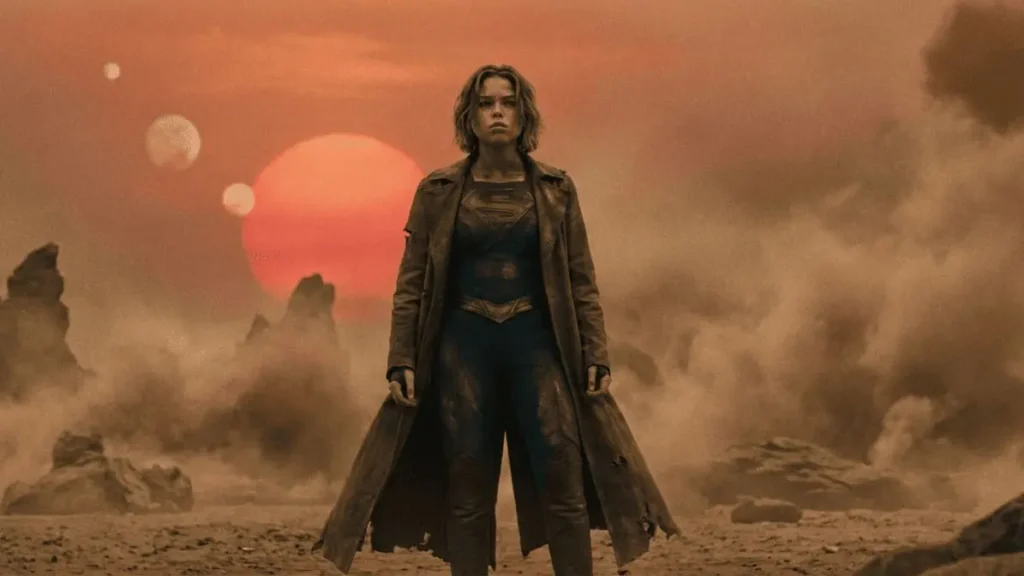
Supergirl sits at the crossroads of several genres at once: space western, road movie, revenge thriller, and superhero origin story. James Gunn has described it as operating like its own standalone graphic novel — entirely self-contained in tone and style, though connected to the wider DCU. The film takes place almost entirely in outer space, visiting planets with red and yellow suns as Kara moves in and out of her powers, making for an unusually grounded and physically vulnerable portrayal of a Kryptonian.
The project is part of DCU Chapter One: Gods and Monsters, Gunn and Safran’s blueprint for the relaunched DC Universe. While Superman (2025) established the tone of hope and optimism, Supergirl explicitly charts the other side of the Kryptonian experience: grief, displacement, and survival without comfort.
The Source Comic: Tom King’s Vision
The film is adapted from the eight-issue limited series Supergirl: Woman of Tomorrow (2021–22), written by Tom King with art by Bilquis Evely and colors by Mat Lopes. The series won the Eisner Award and was widely praised for its literary ambition — King openly modeled it on the novel True Grit, casting Supergirl in the Rooster Cogburn role opposite a young girl named Ruthye who seeks justice for her father’s murder.
The comic opens with Kara on a planet with a red sun — specifically so she has no powers and can get drunk in peace. It’s a deliberately shocking image that immediately signals this is not the cheerful, eager-to-please Supergirl of decades past. King’s writing confronts her survivor’s guilt head-on: unlike Clark, Kara remembers Krypton. She remembers her mother dying from radiation poisoning as Argo City crumbled. She remembers being sent away. That accumulation of loss is the engine of the entire story.
Director Craig Gillespie and screenwriter Ana Nogueira have both cited the comic as their core text, though the film adapts rather than directly translates it. Notably, the character of Lobo (played by Jason Momoa) does not appear in the comic — but was actually part of Tom King’s original pitch for the series before being cut. His reintroduction in the film restores that original creative intent.
Plot Summary
Spoiler-Free Overview
On her birthday, Kara Zor-El finds herself on a remote alien planet with a red sun — powerless and deliberately far from Earth. Her evening is upended when a young alien girl named Ruthye Marye Knoll (Eve Ridley) appears, seeking Supergirl’s help to track down and kill a brutal criminal named Krem of the Yellow Hills (Matthias Schoenaerts). Kara initially refuses, but when Krem attacks and poisons Krypto — her beloved Superdog — she joins the pursuit. What follows is an interstellar chase across multiple worlds, forcing both Kara and Ruthye to reckon with the moral weight of vengeance.
Deeper Story Analysis
The film’s three-act structure — a departure from the more episodic format of the comic — accelerates the relationship between Kara and Ruthye, centering the story on their unlikely companionship. Ruthye narrates the story from an older perspective, giving the film a retrospective, almost literary quality reminiscent of classic westerns.
Krem is not simply a generic villain. The comic frames him as a petty, pathetic man elevated to monster status by the specific cruelties he enacts — which makes him more unsettling than a world-threatening antagonist. His pursuit leads Supergirl and Ruthye into the orbit of the Brigands, a band of intergalactic mercenaries, setting up the film’s action-heavy third act aboard a space pirate vessel.
Lobo enters the narrative as a structural counterpart to Kara — similarly stateless, similarly operating outside conventional heroism — but with none of her moral restraint. Together, they make an odd-couple pairing that injects dark humor into an otherwise bleak road movie.
Kara’s parents, Zor-El and Alura (played by David Krumholtz and Emily Beecham), appear in flashback sequences depicting the destruction of Argo City and Kara’s traumatic childhood — filling in a backstory that Clark Kent never had to carry.
Cast & Performances
Milly Alcock as Kara Zor-El / Supergirl
Australian actress Milly Alcock, who broke out in House of the Dragon as the young Rhaenyra Targaryen, was handpicked by James Gunn before he had even formally taken over DC Studios. Gunn has called her casting potentially the best he has done in his entire career, citing her “edge, grace, and authenticity.” From her brief cameo in Superman — notably hungover and searching for Krypto — it is clear Alcock is playing a version of Kara that is both funny and deeply wounded. The role requires her to carry an entire film largely opposite a young co-star and an alien dog, in a world built entirely from scratch.
Eve Ridley as Ruthye Marye Knoll
Eve Ridley, known from 3 Body Problem, plays Ruthye — the story’s moral compass and narrator. In the comic, Ruthye’s voice is what gives the story its literary texture. She is young, grieving, and utterly determined, and her relationship with Kara forms the emotional spine of the entire film. Ridley’s casting went through an extensive screen test process, with James Gunn having personally reviewed multiple candidates.
Matthias Schoenaerts as Krem of the Yellow Hills
Belgian actor Matthias Schoenaerts (Rust and Bone, The Drop) plays the film’s primary antagonist. Krem is not a powerful supervillain — he is a cruel and cowardly man whose evil is mundane in scale but devastating in personal consequence. Schoenaerts’ background in morally complex, physically grounded roles makes him an ideal fit for a villain who operates on a human rather than cosmic level.
Jason Momoa as Lobo
After departing the DCEU as Aquaman, Jason Momoa makes his DCU debut as Lobo — the last surviving Czarnian, a intergalactic mercenary of near-limitless destructive capability. James Gunn has described Lobo as “the biggest comic book character that’s never been in a film.” Momoa’s role is reportedly a substantial supporting part rather than a brief cameo, and his character serves a specific structural function: helping the film achieve its three-act shape by complicating Kara’s path in ways the comic did not require.
Supporting Cast
David Krumholtz and Emily Beecham play Kara’s parents, Zor-El and Alura, in flashback sequences. Ferdinand Kingsley has been cast as Elias Knoll, Ruthye’s murdered father. Diarmaid Murtagh portrays Drom Baxton, a space pirate aligned with Krem. David Corenswet returns as Clark Kent / Superman in what is expected to be a brief but meaningful appearance.
Director & Production Insights
Craig Gillespie is perhaps best known for directing I, Tonya (2017) and Cruella (2021) — two films about unconventional, morally complicated women that subvert genre expectations. His instinct for character-driven narratives within heightened genre frameworks makes him a natural fit for Supergirl: Woman of Tomorrow.
Gillespie has described reading screenwriter Ana Nogueira’s script and immediately understanding, in a way he rarely does with superhero properties, exactly what tone the film needed to inhabit. He called it the first superhero script where “I could understand the tone and what to do with it.” Gunn gave Gillespie unusual creative freedom, telling him to approach the film as if it were its own graphic novel — unbound by the stylistic grammar of Superman.
Principal photography ran from January 13 to May 2025, primarily at Warner Bros. Studios Leavesden in England, with additional filming in London and Scotland. Additional locations in Iceland were used, likely for alien-planet sequences. Cinematographer Rob Hardy shot the film on IMAX cameras, promising a visual scale commensurate with the story’s cosmic ambitions.
Post-production has involved Industrial Light & Magic on visual effects, with composer Tom “Junkie XL” Holkenborg — a longtime collaborator of Zack Snyder — providing the score after Ramin Djawadi departed the project in early 2026.
Cinematography & Visual Effects
Shooting on IMAX cameras immediately signals an intention to use scale meaningfully rather than decoratively. Unlike the brightly colored, city-centered frame of Superman (2025), Supergirl operates across alien landscapes — planets with red and yellow suns, intergalactic pirate ships, the ruins of Argo City. The visual grammar of the film is reportedly closer to a space western than a traditional superhero spectacle: wide vistas, practical-feeling environments, and a color palette shaped by the type of sun illuminating each world.
ILM’s involvement guarantees technical polish, but what will distinguish the film visually is how Gillespie uses the shifting power dynamics between red and yellow sun environments. In scenes set under red suns, Supergirl is physically ordinary — which grounds action sequences in genuine physical stakes rather than invulnerability.
Themes & Symbolism Analysis
Survivor’s Guilt and the Weight of Memory
The central tension between Kara and Clark — between Supergirl: Woman of Tomorrow and Superman — is the difference between those who remember catastrophe and those who don’t. Clark was an infant when Krypton died. Kara watched it happen slowly. She watched Argo City poison itself under yellow sunlight. She watched her mother die. That memory is not a gift — it is a burden that Clark’s optimism was never required to carry. The film takes that asymmetry seriously in a way no previous adaptation has.
Vengeance vs. Justice
The road-movie structure forces Kara and Ruthye to continually renegotiate the difference between justice and revenge. Ruthye wants Krem dead. Kara — who has a moral code forged from something harder than Clark’s — is not opposed to violence, but she understands its cost in a way Ruthye cannot yet. Their dynamic mirrors True Grit‘s Mattie Ross and Rooster Cogburn, with the older, more experienced figure ultimately more cautious about the outcome of the quest than the younger one driving it.
Heroism Without Performance
One of the most subversive elements of Tom King’s source comic — and, apparently, of the film — is Kara’s complete indifference to being a hero in any symbolic sense. She is not motivated by duty or public image. She acts because things are personal. The film’s marketing has leaned heavily into this: the tagline “Look Out” (a graffiti alteration of Superman’s “Look Up”) positions Kara as someone you respect not because she asks you to, but because she doesn’t.
Comparison to Superman (2025)
James Gunn has been deliberate in ensuring these two films do not feel like chapters in the same story. Superman is optimistic, Earth-bound, and rooted in legacy. Supergirl is darker, cosmic, and rooted in loss. Where Superman finds hope in humanity, Supergirl finds clarity in its absence. Gillespie has confirmed that Gunn explicitly told him not to feel bound by Superman’s visual or tonal grammar — to pursue his own cinematic language entirely.
The tonal contrast is also visible in the marketing. Superman’s poster is bright, heroic, and upward-facing. Supergirl’s teaser poster shows Kara leaning against a vandalized sign — casual, irreverent, and slightly threatening. The costume design similarly splits them: Kara wears a long duster coat over her Kryptonian suit, more outlaw than ambassador.
Early Buzz & Critical Anticipation
The December 2025 teaser trailer generated significant attention across film and comics communities, praised for its confident tonal declaration: this is not a superhero movie in any conventional sense. Commentators highlighted the shift from Superman, the visual specificity of the alien-world design, and the clear chemistry between Alcock and Ridley in their brief shared scenes.
Milly Alcock’s single-scene appearance in Superman (2025) — drunk, funny, sharp-tongued, and immediately compelling — had already generated strong audience goodwill before the film’s own marketing campaign began. The solo trailer confirmed what that cameo suggested: Alcock has found something genuinely new in this character.
Industry tracking has not yet begun in earnest for a June 2026 release, but expectations are high given the reception to Superman and the prestige profile of Gillespie as a director. View the film’s official IMDb page for the latest updates.
Common Misinterpretations
Misinterpretation 1: “The film is a direct adaptation of the comic.”
The film borrows the core characters and major themes of Tom King’s series but restructures the narrative into a three-act format that differs significantly from the comic’s episodic, literary pacing. Several characters — including Lobo and expanded Kryptonian flashbacks — are additions unique to the film.Misinterpretation 2: “Supergirl is just a darker version of Superman.”
The film is not “dark Superman.” It operates in a completely different genre register — a space western road movie — with an entirely distinct visual language, setting, and thematic preoccupation. Darkness is not the point; specificity of character is.Misinterpretation 3: “Jason Momoa’s Lobo is just a cameo.”
While early reports described Momoa’s role as a cameo, subsequent reporting and James Gunn’s own statements suggest Lobo plays a meaningful structural role in the film’s narrative — not merely a fan-service appearance.Misinterpretation 4: “The film is titled Supergirl: Woman of Tomorrow.”
As of June 2025, James Gunn officially shortened the title to simply Supergirl. The subtitle has been dropped from all official materials.
Frequently Asked Questions
When is Supergirl released?
Supergirl opens internationally on June 24, 2026, and in North American theaters on June 26, 2026, distributed by Warner Bros. Pictures.
Who plays Supergirl in the 2026 DCU movie?
Milly Alcock plays Kara Zor-El / Supergirl. She made her first DCU appearance in a brief cameo at the end of Superman (2025), and Supergirl is her first lead role in the franchise.
Is Supergirl: Woman of Tomorrow based on a comic?
Yes. The film adapts the 2021–22 eight-issue limited series Supergirl: Woman of Tomorrow, written by Tom King with art by Bilquis Evely. The series is an excellent standalone read and is widely available in collected edition.
Who is the villain in Supergirl (2026)?
The primary antagonist is Krem of the Yellow Hills, played by Matthias Schoenaerts. Jason Momoa also appears as Lobo, an intergalactic mercenary who complicates rather than opposes Supergirl’s quest.
What is the tone of Supergirl compared to Superman?
Significantly darker and more grounded. Director Craig Gillespie has cited True Grit and Logan as tonal reference points. The film functions as a space western road movie dealing with trauma, loss, and the moral ambiguity of vengeance — a deliberate contrast to Superman’s optimism.
Will Superman appear in Supergirl?
Yes. David Corenswet returns as Clark Kent / Superman. Milly Alcock confirmed the appearance, noting that her first day on set was opposite Corenswet.
Where was Supergirl filmed?
Principal photography took place at Warner Bros. Studios Leavesden and on location in London, Scotland, and Iceland between January and May 2025.
Conclusion
Supergirl: Woman of Tomorrow — arriving in theaters as simply Supergirl on June 26, 2026 — is shaping up to be one of the most creatively daring superhero films in years. By grounding its story in genuine trauma, choosing genre-bending influences like True Grit and Logan, and entrusting the lead role to Milly Alcock, who has already proven she can carry the character’s complexity in a single scene, the DCU is making a strong argument that its second chapter can be as surprising as its first was reassuring.
Whether you are coming to the film via Tom King’s source comic, through Alcock’s Superman cameo, or as a first-time Supergirl viewer, this is a film built to reward engagement on every level. The combination of Craig Gillespie’s character-driven instincts, IMAX-scale cinematography, and a cast that commits to the story’s emotional stakes makes Supergirl one of the most anticipated films of 2026 — superhero or otherwise.
Have thoughts on the Supergirl: Woman of Tomorrow source comic, the teaser trailer, or your hopes for the film? Share them in the comments below, and pass this guide along to any DC fans who want the full picture before June.