The Project Hail Mary movie represents one of the most anticipated science fiction releases of 2026, bringing Andy Weir’s beloved novel to life through the combined talents of Ryan Gosling, directors Phil Lord and Christopher Miller, and an extraordinary creative team. This interstellar adventure promises to deliver the same scientific rigor and emotional depth that made the source material a global phenomenon.
Overview & Genre Classification
Project Hail Mary is an epic science fiction adventure film that blends hard sci-fi concepts with intimate character-driven storytelling. The film falls squarely into the “survival in space” subgenre while incorporating elements of mystery, drama, and surprisingly, comedy. Unlike typical space spectacles that prioritize action over authenticity, this adaptation maintains the scientific accuracy that defined Weir’s novel while crafting a visually stunning cinematic experience.
The production represents a significant departure from recent sci-fi trends, focusing on problem-solving and human ingenuity rather than conventional space battles. Amazon MGM Studios acquired the project with a production budget exceeding $100 million, positioning it as a tentpole release designed specifically for premium large-format exhibition.
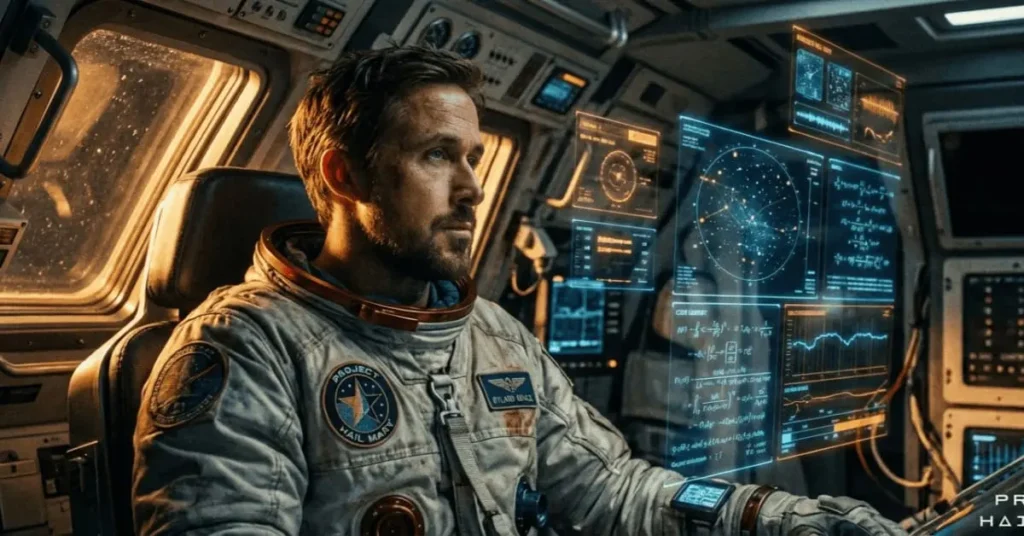
Plot Summary: A Mission to Save Humanity
The Setup Without Spoilers
The narrative begins with middle school science teacher Ryland Grace awakening aboard a spacecraft with complete amnesia. He has no memory of his identity, his location, or his purpose. As consciousness slowly returns, Grace discovers two deceased crew members and realizes he’s millions of miles from Earth with no clear understanding of how he arrived at this dire circumstance.
Through fragmented memories that gradually resurface, Grace pieces together the catastrophic events on Earth: a mysterious substance called Astrophage is consuming the Sun’s energy, threatening all life on the planet with an extinction-level ice age. Every star in the galaxy appears affected except one—Tau Ceti. Grace’s mission becomes clear: he must travel to this distant star system, discover why it remains unaffected, and return with a solution before humanity perishes.
The Deeper Narrative Structure
The film employs a dual-timeline structure that alternates between Grace’s present circumstances aboard the spacecraft Hail Mary and flashbacks revealing the years of preparation on Earth. This narrative approach allows audiences to experience Grace’s memory recovery alongside his current predicament, creating layers of tension as past and present converge.
What begins as a solitary survival story transforms when Grace encounters an alien spacecraft near Tau Ceti. The being inside—whom Grace nicknames Rocky due to its mineral-based carapace—faces an identical crisis on his home world. This unlikely partnership between species becomes the emotional core of the story, exploring themes of cooperation, sacrifice, and the universal bonds that transcend planetary origins.

Cast & Performances
Ryan Gosling as Ryland Grace
Ryan Gosling leads the film as Dr. Ryland Grace, a disgraced molecular biologist turned middle school teacher who becomes humanity’s unlikely savior. Gosling, fresh from his Academy Award-nominated performances in films like La La Land and Barbie, brings both dramatic weight and comedic timing to a role that demands extensive solo screen time. Early preview footage suggests Gosling captures Grace’s transformation from reluctant participant to determined hero, balancing scientific exposition with genuine emotional vulnerability.
Gosling also serves as a producer on the film, demonstrating his commitment to the project beyond performance. His character’s journey requires portraying amnesia, scientific brilliance, physical exhaustion, and ultimately profound friendship with a non-human entity—a challenging combination that plays to Gosling’s strengths as an actor capable of grounding extraordinary circumstances in relatable humanity.
Supporting Cast Excellence
Sandra Hüller portrays Eva Stratt, the ruthless yet brilliant head of the Hail Mary project. Hüller, acclaimed for her performances in Anatomy of a Fall and The Zone of Interest, brings gravitas to a character who must make impossible decisions in Earth’s final hours. Her scenes, primarily featured in the flashback sequences, establish the stakes and moral complexity driving the mission.
The ensemble also includes Lionel Boyce (The Bear), Ken Leung (Lost, Industry), and Milana Vayntrub (This Is Us) in supporting roles that populate Grace’s memories of Earth. Each contributes to the film’s emotional foundation, representing the world Grace fights to save.
Rocky: A Revolutionary Character Achievement
Perhaps the film’s most remarkable casting decision involves Rocky, the alien companion. Legendary puppeteer James Ortiz provides both the physical performance and voice for Rocky, working with creature designer Neal Scanlan’s workshop to create a fully practical puppet enhanced with digital animation. This hybrid approach, supervised by animation director Arslan Elver at Framestore, represents a deliberate choice to maintain tangible presence rather than relying solely on computer-generated imagery.
Directors Phil Lord & Christopher Miller: Visionary Leadership
Phil Lord and Christopher Miller return to live-action feature directing for the first time since 22 Jump Street in 2014, marking Project Hail Mary as their most ambitious undertaking to date. The duo established their reputation through inventive storytelling in The Lego Movie and the groundbreaking Spider-Man: Into the Spider-Verse franchise, demonstrating an ability to balance spectacle with character-driven narratives.
Their approach to Project Hail Mary emphasizes the relationship between Grace and Rocky as the emotional anchor. In preview presentations, Lord explained the film as “genre-defying—emotional, funny, big, with stakes that couldn’t be higher.” Miller added that the story centers on “collaboration and cooperation, and what’s possible if we work together,” positioning the film as optimistic science fiction in an era often dominated by dystopian visions.
The directors’ decision to shoot extensive practical effects, including Rocky’s puppetry, reflects their commitment to grounding the fantastic in physical reality. This philosophy extends throughout production, where real sets, practical spacecraft interiors, and in-camera effects create tangible environments that enhance performance authenticity.
Screenplay by Drew Goddard: Adapting Excellence
Drew Goddard, who earned an Academy Award nomination for adapting Weir’s The Martian, returns to translate another Weir novel for the screen. This marks Goddard’s second collaboration with the author, bringing intimate familiarity with Weir’s narrative voice—scientific precision balanced with accessibility and humor.
Goddard’s challenge involves condensing nearly 500 pages while maintaining the novel’s intricate scientific problem-solving and dual-timeline structure. Early reports suggest the screenplay preserves the book’s core mysteries while making necessary cinematic adjustments. The script reportedly emphasizes visual storytelling over exposition, trusting audiences to follow complex scientific concepts through demonstration rather than explanation.
The adaptation also reportedly makes strategic changes to streamline certain plot elements while preserving the emotional beats that resonated with readers. Goddard’s screenplay balances the intimate character work with the epic scale required for IMAX presentation, a delicate equilibrium that defines successful book-to-film translations.
Cinematography & Visual Mastery
Greig Fraser’s IMAX Vision
Oscar-winning cinematographer Greig Fraser (Dune, Dune: Part Two, The Batman) brings his distinctive visual language to Project Hail Mary, employing IMAX cameras to capture the vastness of space and the intimacy of human connection. Fraser’s approach utilizes different aspect ratios to distinguish between narrative timelines: Earth-based flashbacks appear in traditional 2.39:1 widescreen with a polished, idealized aesthetic, while present-day space sequences fill the entire IMAX 1.43:1 frame with grittier, more tactile imagery.
This technical distinction serves both practical and thematic purposes. The compressed widescreen memories suggest the limitations of recollection—idealized, selective, constrained. The expansive IMAX ratio for space sequences emphasizes isolation, scale, and the overwhelming nature of Grace’s situation. Fraser shot these sequences on film stock rather than digital, maintaining texture and grain that prevents the sterility often associated with space cinematography.
Practical and Digital Integration
The visual effects collaboration involves industry leaders Framestore, Industrial Light & Magic (ILM), Sony Pictures Imageworks, BUF, and Wylie Co. This consortium approach ensures specialized expertise for different sequences—from the bioluminescent properties of Astrophage to the realistic physics of zero-gravity environments.
Fraser’s experience with “The Volume” technology (virtual production environments pioneered on The Mandalorian) informed the production’s approach to combining practical and digital elements. While not exclusively using virtual production, the film benefits from Fraser’s understanding of how to light performers against CG backgrounds, maintaining consistent visual quality across effects-heavy sequences.
The decision to create Rocky through puppetry enhanced with digital animation exemplifies this integration philosophy. Gosling performed opposite a tangible puppet operated by Ortiz and his team, providing genuine interaction points that inform both performance and camera placement. Digital artists then refined and enhanced these practical elements, maintaining the foundational reality established on set.
Music & Sound Design
Composer Daniel Pemberton, who previously collaborated with Lord and Miller on the Spider-Verse films, provides the musical score for Project Hail Mary. This marks the first live-action Lord and Miller film not scored by their frequent collaborator Mark Mothersbaugh, signaling a deliberate tonal shift appropriate to the material’s dramatic weight.
Pemberton’s approach balances orchestral grandeur with intimate moments, reportedly incorporating scientific concepts into the compositional structure itself. The score must serve dual purposes: enhancing the spectacle of interstellar travel while supporting the emotional journey between Grace and Rocky.
Early marketing materials have featured iconic songs including Harry Styles’ “Sign of the Times,” Oasis’ “Champagne Supernova,” and Prince’s “I Would Die 4 U,” suggesting the film incorporates popular music alongside Pemberton’s original compositions—a technique that can ground fantastical scenarios in familiar emotional territory.
Themes & Deeper Meanings
Cooperation Over Conflict
The central thematic pillar explores interspecies cooperation in the face of mutual extinction. Unlike science fiction narratives built on conflict between humans and aliens, Project Hail Mary proposes that survival often demands collaboration. Grace and Rocky’s relationship demonstrates that intelligence, empathy, and shared purpose transcend biological differences—a message particularly resonant in contemporary global contexts.
The Value of Scientific Knowledge
The narrative celebrates scientific literacy and problem-solving as humanity’s greatest assets. Grace’s journey from disgraced academic to middle school teacher to savior of two civilizations validates both specialized expertise and the ability to communicate complex ideas accessibly. The film positions education and curiosity as fundamental human values worth preserving.
Sacrifice and Choice
Without revealing specific plot points, the story confronts characters with profound moral choices between personal survival and collective responsibility. These decisions explore what individuals owe to their species, how we measure the value of sacrifice, and whether heroism requires conscious choice or can emerge from circumstantial necessity.
Friendship and Connection
Beneath the scientific spectacle lies a fundamentally humanist story about friendship formed in isolation. The Grace-Rocky relationship examines how communication transcends language, how trust develops through shared struggle, and how connection provides meaning even in the void of space. This emotional core distinguishes the film from pure scientific speculation.
Source Material: Andy Weir’s Acclaimed Novel
Published in May 2021 by Ballantine Books, Andy Weir’s Project Hail Mary became an immediate bestseller, debuting at number three on The New York Times Best Seller list and remaining on the list for extended periods. The novel earned widespread critical acclaim, becoming a Hugo Award finalist for Best Novel and garnering enthusiastic endorsements from figures including Bill Gates, Barack Obama, George R.R. Martin, and Brandon Sanderson.
Critics praised Weir’s ability to make complex scientific concepts accessible without sacrificing accuracy or narrative momentum. Kirkus Reviews called it “nothing short of a science fiction masterwork,” while The Boston Globe described it as “a suspenseful space yarn that zigs and zags in ingenious directions.” The audiobook, narrated by Ray Porter with unique musical effects for Rocky’s dialogue, won the 2022 Audie Award for Audiobook of the Year.
The novel’s success stems from its balance of rigorous scientific problem-solving with genuine emotional resonance. Weir constructs plausible scenarios grounded in real physics, biology, and engineering while maintaining page-turning pacing through character-driven stakes. Readers responded to Grace’s combination of competence and vulnerability, finding in him a hero defined by intelligence and determination rather than traditional action-hero attributes.
Book vs. Film Considerations: Longtime fans of the novel have expressed concerns about the marketing campaign revealing Rocky’s presence, as the alien’s introduction represents one of the book’s major plot surprises. The filmmakers made the strategic decision to feature Rocky prominently in trailers, likely recognizing that the relationship between Grace and Rocky constitutes the emotional heart that distinguishes the film from similar space survival narratives. While this spoils the reveal for newcomers, it accurately positions the film’s thematic focus.
Production Journey
Development and Pre-Production
Metro-Goldwyn-Mayer acquired Project Hail Mary’s film rights in early 2020 for $3 million—before the novel’s publication. Ryan Gosling signed on to star and produce in March 2020, with Phil Lord and Christopher Miller joining as directors in May. Drew Goddard came aboard as screenwriter in July, completing the core creative team.
The project remained in development for several years, allowing the novel to build its audience and the creative team to refine the adaptation approach. When Amazon acquired MGM in 2022, the project transitioned to Amazon MGM Studios, which announced a 2026 release window in April 2024.
Principal Photography
Filming commenced on June 3, 2024, in the United Kingdom and wrapped on October 26, 2024—a 21-week production schedule. The UK shoot provided access to world-class studio facilities including soundstages capable of housing the spacecraft interiors and supporting extensive practical effects work.
The production employed a combination of traditional sets, motion control photography for spacecraft exteriors, and performance capture for specific alien sequences. Greig Fraser’s team utilized IMAX cameras for the majority of the space-set material, ensuring maximum resolution and dynamic range for large-format exhibition.
Post-Production Excellence
Chris Dickens edited the film, facing the complex challenge of interweaving dual timelines while maintaining narrative momentum and emotional continuity. The editorial process required balancing scientific exposition with character development, ensuring audiences remain invested in Grace’s journey while comprehending the high-stakes scientific problems he confronts.
Visual effects work distributed across multiple vendors allows for specialized attention to different elements: Framestore handled Rocky’s animation and certain space environments, ILM contributed spacecraft and large-scale astronomical phenomena, while Sony Pictures Imageworks, BUF, and Wylie Co. divided remaining effects work according to their specific strengths.
Marketing Campaign & Audience Anticipation
The first trailer launched on June 30, 2025, generating extraordinary response—Amazon MGM Studios reported it achieved the most views for any non-sequel, non-remake film trailer in its first week. This enthusiasm reflects multiple factors: Gosling’s star power following Barbie, Lord and Miller’s reputation, Weir’s devoted fanbase, and genuine hunger for intelligent science fiction.
Subsequent trailers released in November 2025 and February 2026 (the latter during Super Bowl LX) expanded audience awareness while maintaining narrative mysteries. The marketing emphasizes both spectacle and heart, positioning Project Hail Mary as an emotional journey rather than purely visual effects showcase.
Amazon offered Prime members exclusive early access screenings on March 16, 2026—four days before general release—in premium large formats including IMAX, Dolby Cinema, 4DX, and 70mm film presentations. This strategy rewards loyal subscribers while generating pre-release word-of-mouth from enthusiastic fans.
IMAX Experience & Technical Specifications
Project Hail Mary represents one of 2026’s marquee IMAX releases, with approximately 75% of the film presented in the full 1.43:1 IMAX aspect ratio. This expanded frame provides 26% more image than standard theatrical presentations, crucial for capturing the vastness of space and the intricate details of spacecraft environments.
The directors announced plans to strike actual film prints for IMAX 70mm projection in select theaters—a increasingly rare practice that delivers unparalleled image quality. These analog presentations will showcase Fraser’s cinematography in its purest form, free from digital compression and maximizing the tactile, grain-rich aesthetic the filmmakers cultivated.
For audiences seeking the definitive viewing experience, IMAX 70mm film presentations represent the optimal format, followed by IMAX laser projection, Dolby Cinema, and other premium large-format options. The visual design specifically accounts for IMAX’s enhanced brightness, color range, and sound systems, making standard theatrical presentations diminished versions of the intended experience.
Early Critical Reception & Industry Buzz
While formal reviews remain embargoed until closer to release, early preview screenings have generated remarkably positive industry response. Journalists who viewed approximately 30 minutes of footage at IMAX headquarters praised the film’s visual innovation, emotional depth, and successful balance of scientific accuracy with entertainment value.
SlashFilm declared the footage suggests Project Hail Mary “could be 2026’s best sci-fi movie,” noting that Lord and Miller’s approach doesn’t feel derivative of predecessors like The Martian or Interstellar despite surface similarities. Gizmodo emphasized the film’s focus on collaboration and cooperation, themes the directors identified as central to their vision.
Industry observers compare Project Hail Mary’s potential impact to recent sci-fi successes like Dune: Part Two and Arrival—films that demonstrated audiences hunger for intelligent science fiction that respects their intelligence while delivering visual splendor. The combination of commercial appeal and artistic ambition positions the film as both a potential box office success and awards contender.
Comparisons to The Martian and Weir’s Filmography
Inevitable comparisons arise between Project Hail Mary and Ridley Scott’s 2015 adaptation of The Martian, which earned seven Academy Award nominations including Best Picture and grossed over $630 million worldwide. Both films adapt Andy Weir novels featuring stranded astronauts using scientific ingenuity for survival, both feature screenplays by Drew Goddard, and both emphasize humor alongside tension.
However, significant differences distinguish the projects. The Martian centered on solo survival with Earth-based support attempting rescue, while Project Hail Mary incorporates the Grace-Rocky relationship as emotional foundation. The stakes escalate from individual survival to dual-species extinction. The narrative structure differs fundamentally—The Martian employed straightforward chronology while Project Hail Mary weaves dual timelines.
Phil Lord and Christopher Miller’s directorial approach contrasts with Ridley Scott’s classical filmmaking style. Lord and Miller bring sensibilities honed in animation, embracing visual experimentation and tonal flexibility that allows seamless transitions between drama, comedy, and spectacle. Their version promises greater visual inventiveness while maintaining the scientific rigor audiences expect from Weir adaptations.
The Science Behind Project Hail Mary
Andy Weir constructed Project Hail Mary on foundations of legitimate scientific principles, consulting with experts to ensure plausibility. While the Astrophage organism remains fictional, its properties derive from extrapolations of known extremophile biology and energy conversion processes. The spacecraft propulsion systems, while advanced, operate within theoretical physics frameworks rather than fantastical impossibilities.
The film maintains this scientific integrity while making necessary cinematic adjustments. Visual representations of zero gravity, spacecraft design, and astronomical phenomena reportedly reflect contemporary understanding of space travel and astrophysics. NASA personnel who visited the set praised the production’s accuracy in depicting weightlessness experiences—a detail Lord and Miller highlighted as validation of their commitment to authenticity.
This scientific grounding serves narrative purposes beyond mere accuracy. When characters solve problems through legitimate scientific reasoning, audiences engage intellectually alongside emotional investment. The film trusts viewers to follow complex concepts, respecting intelligence while ensuring accessibility through clear visual communication.
Distribution Strategy & Release Plans
Amazon MGM Studios will release Project Hail Mary theatrically on March 20, 2026, in the United States and Canada, with Sony Pictures Releasing International handling distribution in all other territories. This global day-and-date release strategy maximizes opening weekend impact while minimizing piracy concerns.
The theatrical window remains traditionally robust—Amazon has committed to exclusive theatrical exhibition before the film becomes available on Prime Video. This decision reflects confidence in the film’s commercial potential and recognition that premium large-format presentations represent the intended viewing experience.
International markets receive particular attention given the story’s universal themes and global appeal. The film faces competition from Dune: Messiah in May 2026 and Christopher Nolan’s The Odyssey in July, positioning Project Hail Mary strategically in the early spring period when major sci-fi competition remains limited.
Cultural Impact & Franchise Potential
While Project Hail Mary functions as a self-contained narrative, its success could establish foundation for expanded storytelling within Weir’s universe. The novel’s conclusion leaves possibilities open for continuation, though Weir has not published a direct sequel. Strong box office performance could encourage development of related projects or original stories set in the same scientific framework.
The film’s emphasis on international cooperation and scientific problem-solving positions it as potentially significant cultural artifact beyond entertainment value. Educational applications seem inevitable—science curricula could utilize sequences demonstrating scientific method, physics principles, or mathematical problem-solving in accessible dramatic contexts.
Rocky’s character represents breakthrough achievement in depicting non-humanoid alien intelligence without resorting to anthropomorphization. If audiences embrace this truly alien being as the filmmakers hope, it could influence how future productions approach extraterrestrial character design and storytelling.
Behind-the-Scenes Excellence
Production Design
The spacecraft interiors balance scientific functionality with visual interest, avoiding the sterile aesthetics that plague lesser productions. Production designers created environments reflecting years of isolation—worn surfaces, improvised repairs, personal touches that humanize technological spaces. These details ground the fantastic in relatable reality.
Costume Design
Ryland Grace’s costume evolution tracks his character journey. The specialized bathysphere suit designed for extreme environments represents major design achievement, balancing practical functionality with visual distinctiveness. Each costume element serves narrative purpose while maintaining scientific plausibility.
Creature Design
Neal Scanlan’s legendary creature shop, responsible for recent Star Wars and Harry Potter designs, created Rocky through extensive research and development. The character required biological plausibility for an ammonia-based lifeform while maintaining expressive capability despite lacking eyes or familiar facial features. The crystalline mineral exterior reflects alien beauty while suggesting evolutionary adaptation to different environments.
What Sets Project Hail Mary Apart
In a cinematic landscape crowded with franchise installments and safe bets, Project Hail Mary represents ambitious original storytelling (adaptations of novels qualify as original in film industry terms). The film eschews cynicism for hope, conflict for cooperation, and spectacle for substance without sacrificing visual grandeur.
The Grace-Rocky relationship offers something genuinely novel: a buddy dynamic between species that shares no evolutionary history, biology, or sensory perception. Their friendship develops through scientific collaboration and mutual respect rather than forced sentimentality—a mature approach to interspecies contact rarely attempted in mainstream cinema.
Phil Lord and Christopher Miller’s return to live-action feature directing brings renewed energy to the form after years focused on animation. Their genre-fluid sensibilities allow Project Hail Mary to function simultaneously as hard science fiction, survival thriller, mystery, comedy, and emotional drama without feeling tonally inconsistent.
Conclusion
Project Hail Mary arrives at a pivotal moment for science fiction cinema, demonstrating that audiences hungry for intelligent, emotionally resonant storytelling will embrace films that respect their intelligence. The combination of Andy Weir’s scientifically grounded narrative, Drew Goddard’s proven adaptation skills, Phil Lord and Christopher Miller’s innovative direction, Ryan Gosling’s star power, and Greig Fraser’s visual mastery creates rare synergy where every element reinforces the whole.
The film’s themes—cooperation over conflict, scientific knowledge as salvation, sacrifice for collective good, and friendship transcending difference—resonate beyond entertainment into broader cultural conversations. If Project Hail Mary succeeds both commercially and artistically, it could revitalize studio confidence in original science fiction properties that prioritize ideas alongside spectacle.
For audiences seeking hope without naivety, science without sterility, and spectacle with substance, Project Hail Mary promises an experience that honors both heart and mind. The theatrical release on March 20, 2026, represents not merely another blockbuster launch but potentially a landmark moment demonstrating cinema’s continued capacity for wonder, intelligence, and emotional truth.
Whether you’re a devoted reader of Weir’s novel, a fan of the creative team’s previous work, or simply someone seeking great science fiction, the Project Hail Mary movie deserves your attention on the biggest screen possible. This is cinema designed for IMAX, crafted by artists at the height of their powers, telling a story that matters.